
Class 05: Hypothesis testing
Last update: 03 March, 2026
#Randomizations, #Statistical tests, #ER, #SBM #agent based models
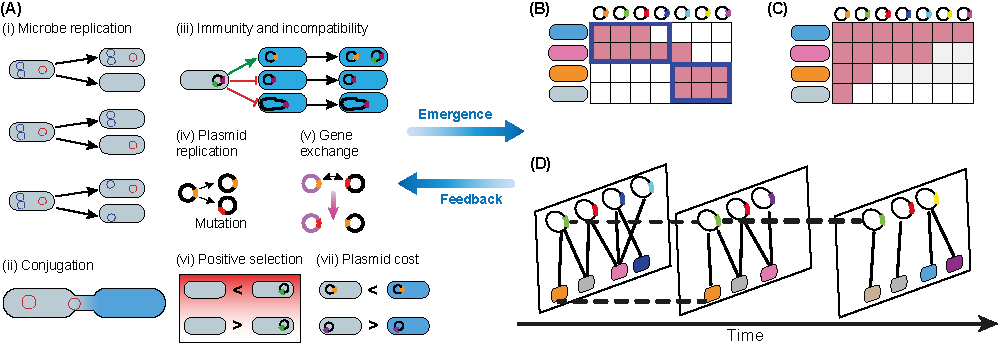 Figure
from: Pilosof
2023, Trends Microbiol.
Figure
from: Pilosof
2023, Trends Microbiol.
Summary
In network ecology, observed metrics like nestedness, modularity, or motifs are statistically meaningless without a reference point. To determine if a network’s structure is driven by biological mechanisms (such as resource selection) or is simply a neutral byproduct of connectance and abundance, we must compare it to a baseline. This class explores two types of reference baselines: non-parametric randomizations, and generative models (mechanistic recreations). We focus primarily on Null Models, which use randomization algorithms to shuffle data while preserving specific biological constraints.
Slides
Goals
Introduce the theoretical spectrum of reference baselines, ranging from parametric point-hypothesis tests to constraint-based null models and mechanistic generative models.
Provide the computational tools and statistical logic needed to implement randomization algorithms (e.g., Curveball) and interpret the significance of network patterns using P-values and Z-scores.